About New England Victrola LLC

New England Victrola LLC
I am Jonathan Sheffield, owner of New England Victrola LLC in Connecticut, a company dedicated to the complete restoration and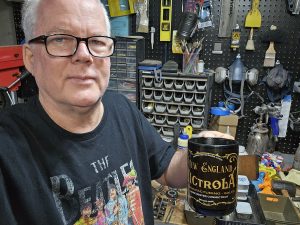 remanufacturing of Victor Victrola phonographs.
New England Victrola specializes exclusively in phonographs manufactured by the Victor Talking Machine Company. While there are a small number of businesses around the country that perform complete antique phonograph restorations, New England Victrola is unusual in concentrating specifically on Victor Victrolas.
What a Complete Victrola Restoration Means
A complete restoration is far more involved than simply refinishing a cabinet or getting an old motor running again. Nearly every removable component of the Victrola is disassembled and individually restored.
Over the years, I have developed a detailed restoration process that essentially remanufactures the phonograph, bringing its appearance and mechanical operation as close as practical to showroom condition.
Nothing is considered insignificant. The spring motor, reproducer, tonearm, motor board, brake, speed control and other mechanical components are restored, but so are the smallest details—the hinges, knobs, hardware, screw heads and other pieces that are often overlooked.
Our shop is intentionally small, with the capacity to produce approximately one completely restored Victrola per month and 3-4 Motors, Tone Arms, Reproducers & Turntables per week shipped in from all over the country. This allows us to concentrate on quality rather than volume.
Cabinet Restoration and Refinishing
Whenever possible, an original Victor finish that remains in good condition is preserved and repaired. This may involve cleaning, localized finish repairs and the careful application of additional shellac.
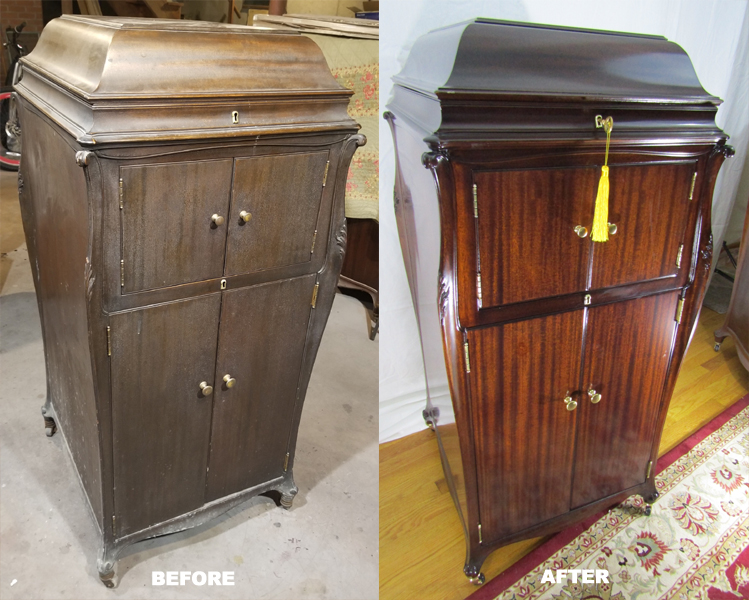
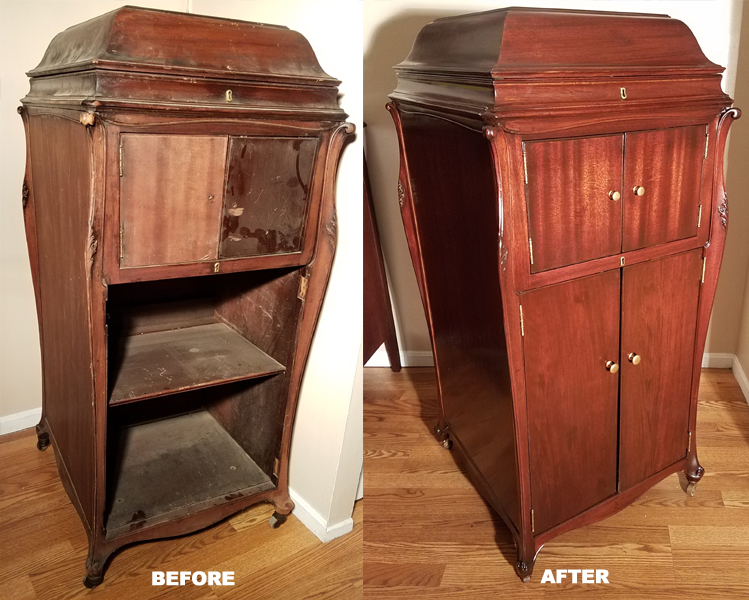
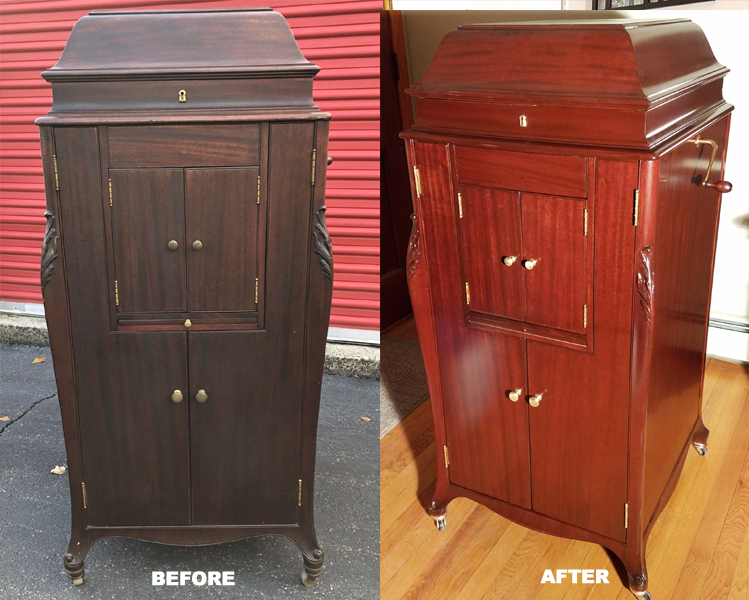
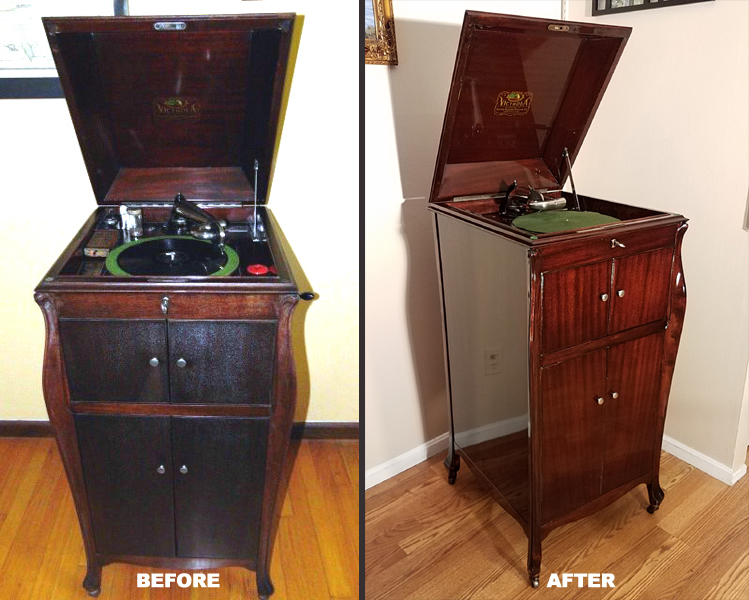
Unfortunately, many Victrolas have spent decades in basements, attics, garages and other environments that have left their original finishes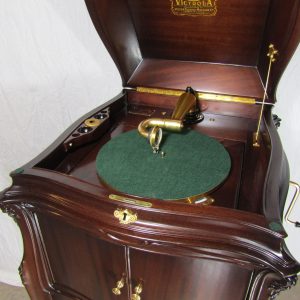 beyond practical preservation. When this happens, the cabinet requires complete refinishing.
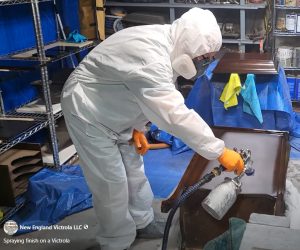
The process can include stripping the deteriorated finish, initial sanding, extensive detail sanding, veneer repairs when necessary, color matching with dyes and stains, sealing and applying multiple finish coats. Level sanding is performed between stages to produce a smooth, consistent final surface.
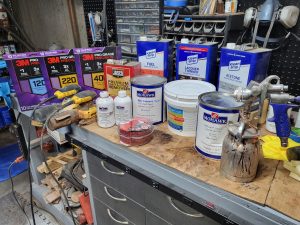 I use professional spray equipment and high-quality Mohawk finishing products throughout the refinishing process. My objective is not simply to make an old cabinet shiny again. The goal is to retain the character and appearance appropriate to a Victor phonograph while producing a finish capable of lasting for generations.
Mechanical Restoration
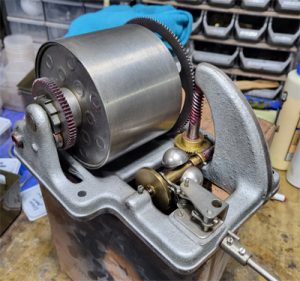 I have an assistant who specializes in rebuilding our spring motors. I originally taught him my rebuilding process, and over time he became
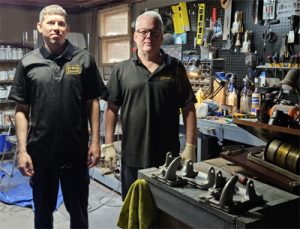 exceptionally skilled and efficient at it. Having a dedicated motor specialist allows me to concentrate on the cabinet, hardware, tonearm, controls and final assembly while maintaining a consistent standard throughout the restoration.
The motor is normally rebuilt before restoration of the cabinet and hardware begins.
 Our shop was rebuilt several years ago specifically around the Victrola restoration process. Virtually everything in it has a purpose related to restoring these machines.
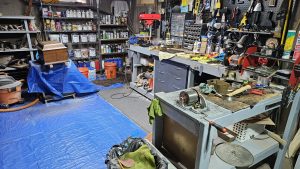 One workbench is dedicated primarily to tonearms, motor boards, brakes, speed controls, hardware and final assembly. Another is dedicated specifically to motor rebuilding and contains the specialized tools, synthetic greases, lubricants and supplies required for that work.
The result is essentially a small specialized workshop built around one purpose: restoring Victor Victrolas.
About Jonathan Sheffield
I have been restoring and repairing things for as long as I can remember. As a young teenager, people called me “Mr. Fix-It.” If something was broken, I wanted to understand how it worked and figure out how to repair it.
My interests eventually included automobile restoration and mechanical work, houses, furniture and antiques. Those different skills ultimately came together in a way I never anticipated.
Around 1980, I inherited a 1909 Sessions mantel clock that had been in my family for generations. It was in poor condition, and around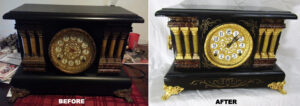 2011 I finally gave it its first complete restoration. That project led me into restoring antique clocks. I began buying clocks, mechanically and cosmetically restoring them and selling them. Over the years, I restored well over 100 clocks.
But another experience had stayed in the back of my mind.
Around 1999, I visited my cousin Jenny, who played her antique crank phonograph for me. I loved it. There was something fascinating about hearing recorded music produced entirely mechanically by a machine built generations earlier.
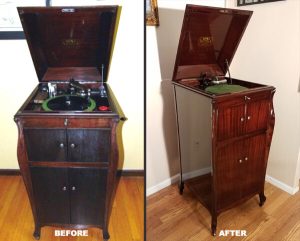 Around 2010, I purchased my first Victrola from a man in Rhode Island. I didn’t realize it at the time, but it was a very common VV-100 from around 1920. It was in poor condition, which made it a perfect project.
I completely disassembled it and taught myself how the Victor spring motor worked. The motor came apart, everything was cleaned and serviced, the hardware was polished, the cabinet restored and the machine carefully reassembled. When it was finished, it looked and operated like a completely different Victrola.
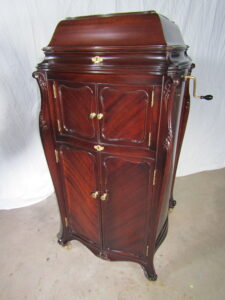
I sold that machine and moved on to something more challenging: a 1918 VV-XVI with gold-plated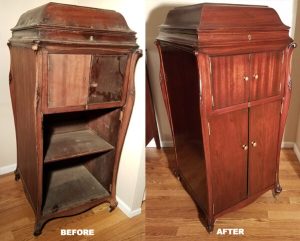 hardware. It was in terrible condition and required significant work, including veneer replacement. But I loved the process, and seeing the finished machine was tremendously satisfying. That Victrola was eventually sold and shipped to an out-of-state buyer.
At the time, the business was called New England Victrola and Clock. As Victrolas increasingly became my focus, I decided to leave the clock side behind. When I formally registered the business in Connecticut and with the federal government, it became New England Victrola LLC.
Experience Beyond Victrolas
New England Victrola isn’t something I started after retiring—I still work full-time.
 For more than 26 years, my primary profession has been in the office furniture restoration industry, and I currently work for a multimillion-dollar Connecticut company. That experience has been extremely valuable to the Victrola business. Furniture restoration taught me a great deal about wood, veneers, finishes, repairs and the practical challenges of restoring large pieces.
It also helped me develop methods for safely packing and shipping restored Victrolas throughout the United States.
Over the years, my Victrolas have gone to collectors and customers across the country, including museums, buyers throughout the Midwest and West Coast, and Tyler Perry Studios.
Music is the other major part of my life. In addition to operating New England Victrola, I am a member of the Refocus Classic Rock Band,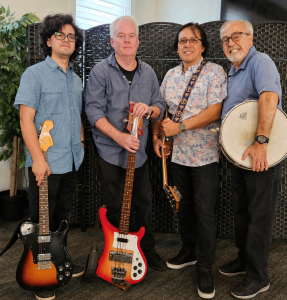 where I sing lead vocals and play bass. We perform private events and other engagements throughout Connecticut, Massachusetts, Rhode Island and New York.
That makes for a busy schedule. Many weeks amount to working my regular job Monday through Friday, performing with Refocus on Saturday, working on Victrolas on Sunday—and then returning to the Victrola shop during evenings throughout the week.
But I enjoy all of it.
Where It All Comes Together
Looking back, becoming a Victrola restoration specialist makes perfect sense. My love of music gave me an appreciation for what these machines were created to do. My mechanical experience taught me how to understand, disassemble and rebuild their spring-driven mechanisms. My experience restoring antique clocks taught me patience and how to work with century-old mechanical components and more than two decades in furniture restoration gave me the woodworking, veneer, finishing and refinishing experience necessary to properly restore their cabinets.
All of those skills eventually came together in one place: New England Victrola LLC.
Today, I have built a strong reputation within the antique phonograph community. I also try to give something back to the hobby by sharing what I have learned with newer collectors and restorers through social-media groups.
After restoring these machines for many years, I still get the same satisfaction from the final result that I got from my first Victrola.
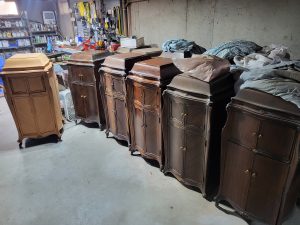 There is something special about taking a Victor phonograph that has survived for more than a century—sometimes neglected, damaged and no longer working—and bringing its cabinet, hardware and mechanical components back to life.
That is what New England Victrola is all about: preserving these remarkable machines so they can look beautiful, play music and be enjoyed for another hundred years.
Before and After Restorations